CRM guide for clinics and health centers: inquiries, examinations and post-treatment follow-up
We explain the stages, assignment rules and KVKK safeguards that help a multi-department clinic get inquiries to the right team, track the move from examination to treatment and make sure patients aren’t left on their own after a procedure.
By BEF CRM Ekibi Updated

Contents 9 sections
A multi-department clinic receives dozens of different inquiries in a single day: one patient asks about available days for dermatology, another wants a check-up price, another writes in a foreign language. When an inquiry lands with the wrong person, it either waits or never gets a reply. Whether treatment started after an examination often goes untracked as well.
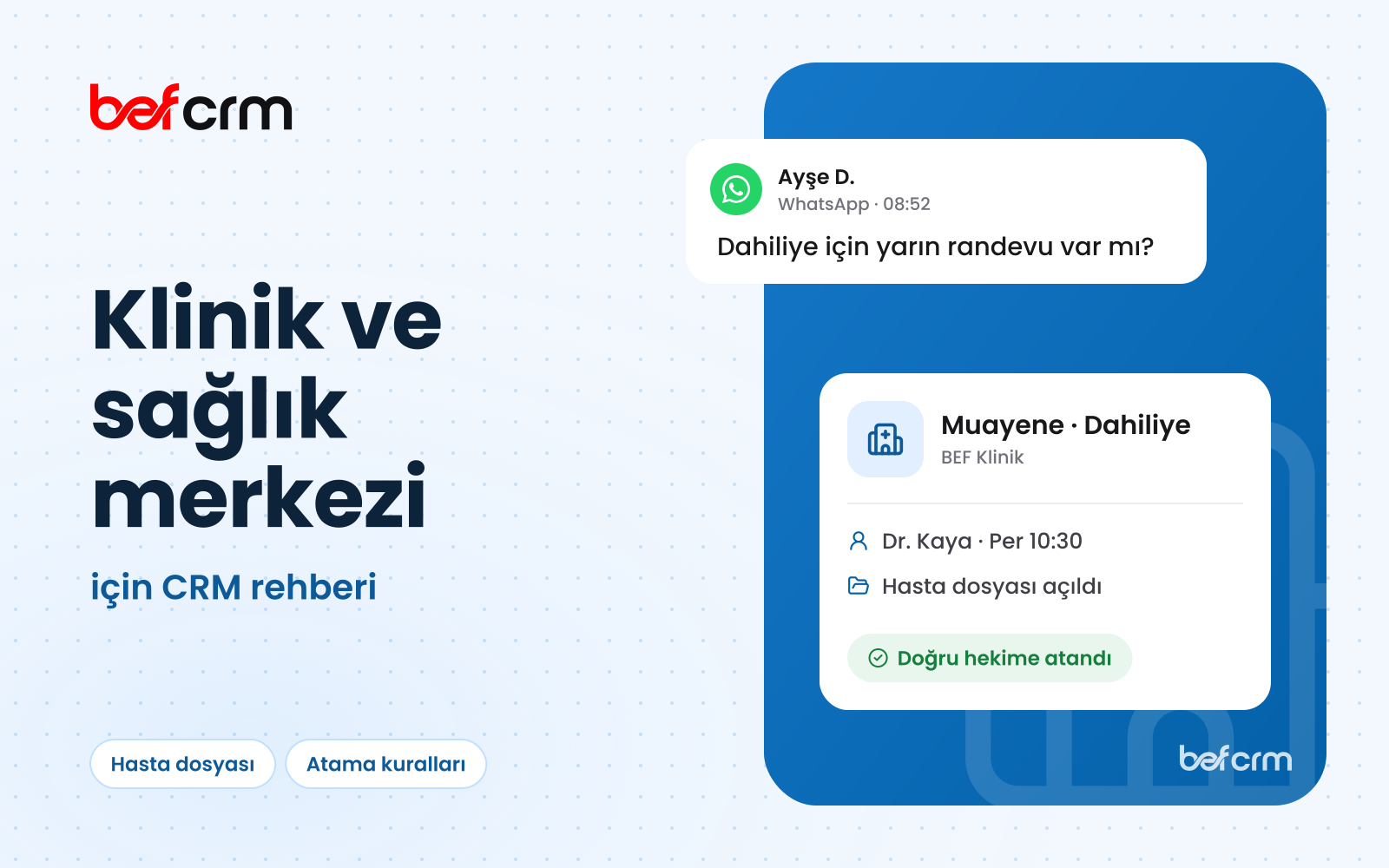
In this guide, we explain how a clinic or health center can route inquiries to the right team, track the move from examination to treatment on the board and organize post-procedure follow-up. As an example, picture a fictional health center called BEF Klinik. A summary of the preset settings is on the Clinics and health centers page.
Health data and KVKK: not legal advice
Clinical records contain health data and, under KVKK, are subject to stricter rules as special categories of personal data. Your privacy notice, legal grounds, cases requiring explicit consent and retention periods should be determined specifically for your clinic with a lawyer. In BEF CRM, patient file fields are stored encrypted, only authorized staff can see them and every access is written to a log; without consent, no clinical record is created, and clinical data whose retention period has expired can be destroyed. This note is general information; for current regulations, follow the Personal Data Protection Authority’s website.
Where do inquiries come from, and where do they go?
Most clinic inquiries come from website chat, WhatsApp and Instagram. With website chat, visitor messages land in the same inbox as other channels. Smart assignment rules send the inquiry to the relevant team based on source, connected account, campaign, city, language or a custom field; if you keep the department as a custom field, you can distribute by department. Rules are tried in order, the first match applies and the reason for every assignment is written to the record’s history.

Stages and naming
With the industry settings, the board comes with four stages; leads appear as “Prospective patients”, customers as “Patients” and sales as “Treatments”.
| Stage | When does a record move here? | Work at this stage |
|---|---|---|
| Info provided | Information given about the department, doctor and available days | Send the booking link |
| Examination appointment | Day and time set | Check that intake questions were answered and the reminder went out |
| Examined | The patient was examined, and the doctor’s note went into the file | If treatment was recommended, plan the next step |
| Treatment started | The patient started treatment | Start the follow-up plan |
To track examination-to-treatment conversion on the board, give the “Examined” stage a suitable follow-up time. Patients who were recommended treatment but didn’t start pile up in this stage; be sure to check this list in your weekly review.

Close reasons and follow-up
The preset close reasons are: Found the price too high, Not covered by insurance, Appointment date didn’t work, No need right now, Chose another clinic.
- Found the price too high: a task is created for the rep in the next campaign period.
- Appointment date didn’t work: a task is created for the rep 7 days later; share new available days when you follow up.
- Not covered by insurance: make a note so you can let them know when your list of contracted institutions changes; scheduled follow-up usually isn’t needed.
- Chose another clinic: no follow-up needed; if this reason shows up often, it’s a sign to review your response time.
You can change rules and timings on the tasks and reminders screen.
Patient file, consent and follow-up plan
The client / patient file module holds medical history, allergy and medication information, session notes and attachments. KVKK explicit consent and procedure consent are signed on screen and archived as PDF. Treatment plan templates bring up checkup days; each step opens as a task or message when its turn comes.

Hasta belirti bildirirse aciliyete göre sorumluya anında bildirim gider; bildirimde sağlık ayrıntısı yazılmaz. Kontrol randevuları için periyodik hatırlatma kurulur, gelmeyen hastalar takvimde durum rengiyle görünür. Önerilen modüller: Randevu ve seans, Danışan / hasta dosyası, Onam ve sağlık formları, Tedavi / takip / program planı, Periyodik hatırlatma, Belirti / şikayet triyajı. Ayrıntılar: sektör modülleri.

Who sees what?
In the Team, permissions and KVKK settings, every user works under a role. While the call center or front desk sees appointment and contact information, clinical notes should be visible only to authorized doctors and healthcare staff. Make two-step verification mandatory for the whole team, and revoke access for departing staff on the same day. Consent records, KVKK requests and retention periods are managed in the compliance center.
AI assistant
Outside working hours, the assistant can share information such as departments, doctors’ working days, the address and the booking link. Diagnoses, treatment recommendations, medication doses and interpreting test results are not the assistant’s job; prohibit them explicitly in the knowledge base. Make sure conversations containing words like “urgent”, “shortness of breath” or “bleeding” are handed over to a staff member, and write at the top of the knowledge base that 112 should be called in emergencies. For patients who write in a foreign language, automatic translation shows the message in Turkish.
Campaigns and consent
Promotional messages such as a check-up or screening campaign require commercial message consent; the campaigns screen automatically skips people without consent. Advertising of healthcare services is also subject to professional and administrative regulations; check your texts against these rules.
What to check in the weekly report
- Inquiries awaiting a reply, by department and rep.
- Patients who were examined but didn’t start treatment, and their close reasons.
- Appointments marked no-show on the calendar.
- Overdue checkup steps and triage notifications.
Wins and stage durations by rep are in the detailed view of the dashboard.
First-week checklist
- Connect website chat and your WhatsApp and Instagram accounts.
- Add custom fields to hold department and language information, set up assignment rules and test them with “Simulate”.
- Define roles; open clinical notes only to authorized staff, and make two-step verification mandatory.
- Review your explicit consent and procedure consent form texts with your lawyer.
- Prepare a follow-up plan template with checkup days for your most common treatment.
- Write the assistant’s knowledge base; add prohibited topics and handover words.
How do I distribute inquiries by department?
Keep the department in a custom field and define a condition on that field in your assignment rules. Rules also work by language, city or source; distribution can be round-robin, to whoever has the fewest open records, or weighted.
Can the secretary see patient notes?
That’s determined by role settings. Clinical fields in the patient file are stored encrypted and open only to authorized staff, and every access is written to a log.